
Introduction
Many Nigerian students study for hours and still forget most of what they read. They sit with a book and hope the words stay, then panic when the test looks new. This guide explains how to study effectively in a way that actually works here, in a noisy house, with little money and with school, church and chores around you. These tips on how to study effectively for Nigerian students are practical: each one comes from a method that has been tested on real students, with steps you can copy today and keep using for WAEC, NECO and JAMB.
1. Active Recall: Test Yourself, Don’t Just Re-Read
Active recall means closing the book and trying to remember what you just studied. Read a topic once, then put the book aside and write down everything you can remember about it. Only then open the book and check what you missed. It feels harder than re-reading, and that is why it works: the struggle to recall strengthens the memory. Re-reading only gives recognition — the feeling that something looks familiar — while exams test recall. Try it with Biology: read about photosynthesis, close the book, and write down all you remember.
2. Spaced Repetition: Review Before You Forget
Cramming fails because the brain forgets a single long push. Spaced repetition means reviewing the same material at increasing intervals — after one day, after three days, after a week, then after two weeks. Each review is shorter than the first study session, but it pushes the memory deeper. When you finish a topic, write the next review dates on your notes: tomorrow, in three days, next week. When the date comes, test yourself for ten minutes. A topic reviewed four times over two weeks stays with you far longer than the same topic read four times in one night.
3. The Pomodoro Technique: Study in Focused Blocks
Long, unbroken study sessions make you tired, and your concentration drops without you noticing. The Pomodoro technique breaks study into short, focused blocks: 25 minutes of full concentration, then a five-minute break. After four blocks, take a longer break of 20 to 30 minutes. During a block, do only one thing, phone on silent and out of reach. When the timer rings, stop, stretch, and rest properly. The exact length matters less than the pattern: focus, break, focus, break. Four honest blocks in an evening beat three hours of staring at a page while your mind wanders.
4. Teach It to Someone Else
If you can explain a topic in simple words to a friend, a sibling or a classmate, you really understand it. If you cannot, you have found a gap — and that gap is useful information. Pick a topic, explain it out loud as if you were teaching a younger student, and notice where you get stuck, use vague words, or skip a step. Go back to your textbook for exactly those parts, then explain it again. You do not need a real audience: an empty chair or your phone’s voice recorder works too. In a study group, take turns teaching a topic for ten minutes while the others ask questions. The teacher learns the most.
5. Interleaving: Mix Your Subjects
Studying one subject for five hours straight feels thorough, but it makes it harder to tell ideas apart in the exam. Interleaving means mixing topics in one session — 45 minutes of Mathematics, then 45 of English, then 45 of Biology — instead of a whole evening on one subject. Mixing forces your brain to choose the right approach each time you switch, and that is exactly what an exam asks you to do. JAMB, for example, makes you switch between four subjects inside two hours — so first make sure those four subjects are the right ones for your course, with our guide JAMB Subject Combinations Explained: How to Choose the Right Ones.
6. Mind Maps: Draw the Connections
Some topics are hard to learn from a list because the ideas connect to each other. Mind maps help with those. Write the main topic in the centre of a page, draw branches for the main ideas, and smaller branches for the details, examples and definitions. Mind maps work well for Biology, Government and Literature. For Biology, put ‘The Heart’ in the centre, with branches for structure and blood flow. Keep the map to one page and use short words, not sentences. The point is not a beautiful diagram: you built the connections yourself, and building them is what makes them stick.
7. Write Summaries in Your Own Words
After studying a topic, write a short summary in your own words — half a page at most. Do not copy sentences from the textbook. If you have to put the idea into your own words, you have to understand it first, and that effort is the learning. Keep these summaries in a separate notebook as your revision notes. In the last week before an exam, read your summaries, not the whole textbook.
8. Use Past Questions as a Test, Not a Textbook
Past questions are one of the best study tools — but only when you use them as a test. Do not read through a past-question book and its answers like a novel; that teaches you to recognise answers, not to produce them. Instead, pick a topic you have just studied, answer its past questions without help, and mark yourself honestly. Then sort your mistakes: did you not know the topic, misread the question, make a calculation slip, or run out of time? Each needs a different fix — more study, slower reading, or more practice with working shown step by step. Keep a record of the topics you keep missing — those topics, not the ones you already know, are where your next study hours should go. For a full JAMB plan built around these methods, see our guide How to Pass JAMB in One Sitting: A Step-by-Step Study Plan.
9. Study at Your Best Time, in Your Best Place
Not every hour is equal. Some students think clearly in the early morning, others in the evening. Notice when your concentration is strongest, and give your hardest subject to that time. Give easier work to the times when you are tired. Your place matters too: find one regular spot — a corner of your room, a library desk — and your brain will learn to associate it with focus. In Nigeria, plan for power cuts and noise: keep a charged torch ready and your notes within reach without power.
10. Protect Your Sleep, Your Breaks and Your Phone
Sleep is not a break from studying; it is part of it. While you sleep, your brain moves the day’s learning into long-term memory. A student who studies until 2 am and sleeps four hours remembers less than one who stops at 10 pm and sleeps eight. Aim for seven to eight hours a night, especially before an exam. Breaks work the same way: a ten-minute walk and a glass of water bring back more concentration than pushing through tiredness. And the phone is the biggest enemy of effective study: one notification breaks your concentration, and it takes minutes to get it back. During a study block, put the phone on silent and out of reach, and check it only during breaks.
How to Study Effectively: A Simple Day That Uses All Ten Methods
One ordinary school day: review flashcards in the morning; after school, study a new Mathematics topic, then close the book and write what you remember; summarise an English passage; draw a Biology mind map and answer its past questions; explain one topic out loud. Then sleep on time. About two and a half hours of real study — worth more than five hours of re-reading.
Common Mistakes to Avoid
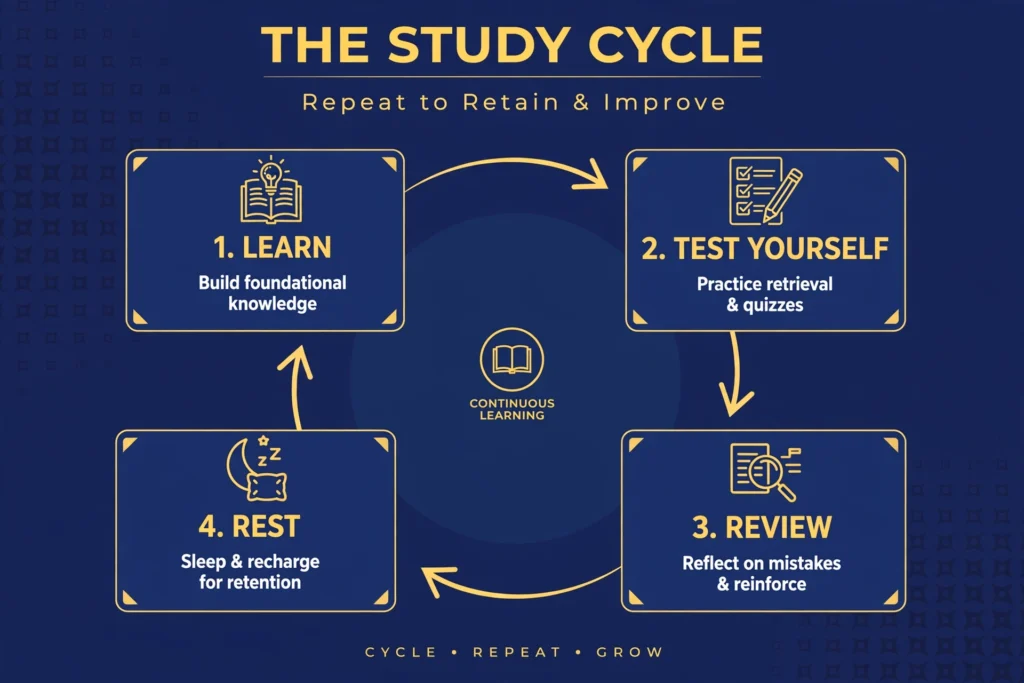
First, studying for hours without ever testing yourself: hours are not the measure; what you can recall without the book is. Second, cramming the night before — most of it is gone by morning. Third, copying notes beautifully and never using them. Fourth, studying only your favourite subject. Finally, comparing your method to a friend’s: the best method is the one you will actually use, every day, for weeks. Pick two or three methods, use them for two weeks, and keep the ones that work.
Conclusion
Learning how to study effectively is not about studying longer. It is about studying in a way your brain can keep: test yourself instead of re-reading, space your revision out, work in focused blocks, teach what you learn, mix your subjects, draw the connections, summarise in your own words, use past questions as a test, study at your best time and place, and protect your sleep, your breaks and your phone. Start with active recall and spaced repetition, and add the others one at a time. In a few weeks, you will feel the difference, and in the exam hall, you will see it.