
Introduction
WAEC 2027 is the exam that decides whether most Nigerian students can move on to university, a polytechnic or a college of education. A good JAMB score helps — if you are also sitting JAMB, see our guide How to Pass JAMB in One Sitting: A Step-by-Step Study Plan — but without the right WAEC credits, admission will not happen. That is why WAEC deserves its own plan, not the same plan you use for JAMB. This guide explains how to pass WAEC in one sitting, honestly and without expo: how WAEC works, what ‘passing’ really means, and how to prepare for WAEC 2027 step by step — including the essay papers, the practicals, and exam technique.
What Does Passing WAEC Actually Mean?
For admission in Nigeria, the usual requirement is at least five credit passes, including English Language and Mathematics, plus the subjects your course demands. Under the WAEC grading system, each subject is graded from A1 (the best) down to F9 (fail), and a credit is A1 to C6. A D7 or E8 is a pass, but it is not a credit, and it will not count where a credit is required. You are not aiming for ‘a good result’ in general. You are aiming for five specific credits, and you need to know exactly which five — or more — your course needs, so check the admission requirements of the schools you want and write your own target list down. Aim higher than C6 in your most important subjects.
How WAEC Works, in Plain Terms
WAEC stands for the West African Examinations Council, and the exam is called the West African Senior School Certificate Examination, or WASSCE. It is taken by school candidates, usually in SS3, and by private candidates in a separate series. Unlike JAMB, WAEC is not only multiple-choice questions on a computer. Most WAEC subjects have more than one paper: an objective paper of multiple-choice questions, an essay or theory paper of written answers, and, for the sciences and some other subjects, a practical paper where you carry out experiments or tasks and record what you observe. Each paper is scored separately, and your final grade comes from all of them together. You cannot pass on objectives alone — if you never practise essay answers or touch the practical apparatus, you are leaving marks on the table.
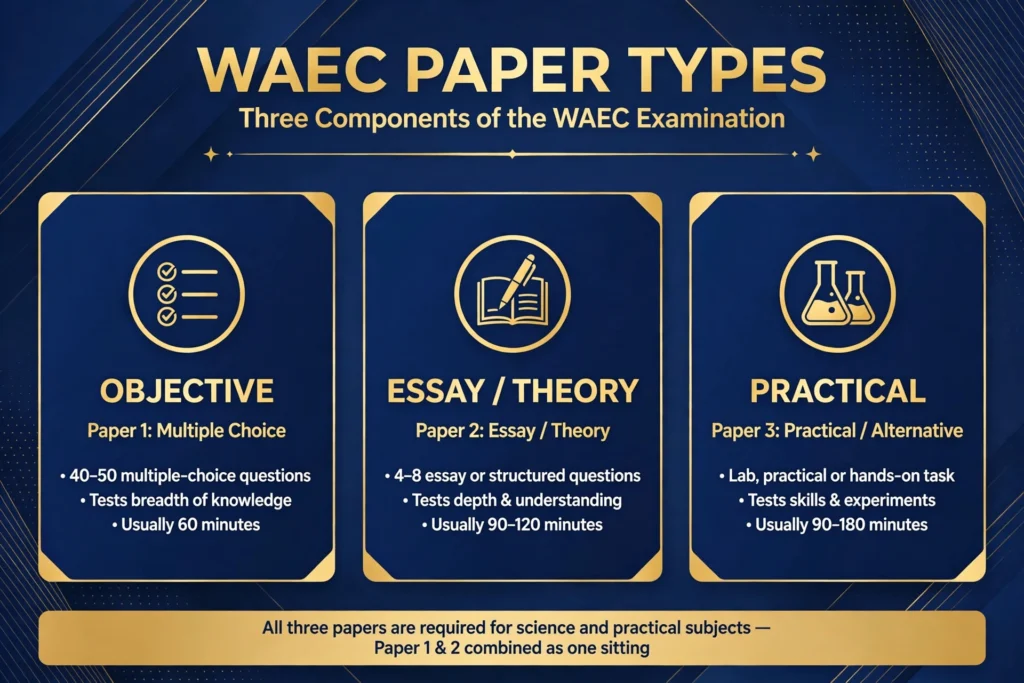
You register for a minimum of eight subjects and a maximum of nine. English Language and Mathematics are compulsory for almost every candidate. The rest depend on your course and your school.
How to Prepare for WAEC 2027 in 7 Steps
Step 1: Write down your target credits. Before you open a textbook, write down the course you want, the schools you want, and the five or more credits you need. Ask a teacher to check your list. This list is your real goal. Your JAMB subjects must match your course too — check them with our guide JAMB Subject Combinations Explained: How to Choose the Right Ones before you register.
Step 2: Study from the syllabus, not just your textbook. Every mark in WAEC comes from the WAEC syllabus — the official list of topics that can be examined in each subject. Get the current syllabus for every subject you registered, and turn each one into a checklist. Tick topics off as you finish them, and mark the ones you find hard so you can return to them. A textbook is useful, but it is not the syllabus: textbooks often contain extra topics and skip others the syllabus includes.
Step 3: Build a timetable you can actually keep. WAEC rewards steady work over months, not a final rush. Start at least three to four months before the WAEC 2027 exam if you can, and study a little every day. A simple pattern for a student in school: one subject for 60 to 90 minutes after school, plus 30 minutes of English or Mathematics every evening, because those two subjects are compulsory and carry the most weight. On Saturday, work on your weakest subject in the morning and review your mistakes in the afternoon. Keep Sunday light, for revision and rest.
Step 4: Use WAEC past questions properly. WAEC follows patterns. The topics, the question styles and even the phrasing often repeat from year to year, even when the exact questions change. WAEC past questions are therefore one of the best ways to prepare — but only if you use them the right way. Do not just read past questions and their answers; that feels like study, but it teaches you very little. Instead, try a set of questions without help, mark yourself honestly, and then go back to your textbook for every topic you got wrong. Work through WAEC past questions by topic first, so you can see which topics appear often. Closer to the exam, work through whole papers under time, exactly as you will on the day.
Step 5: Give each subject its own plan. English Language: Practise essay and letter writing, summary writing and comprehension every week. Learn the rules of lexis and structure, and read widely, because reading builds the vocabulary WAEC rewards. Mathematics: Do problems every day. Keep a formula sheet and learn what each formula means. Pay special attention to the topics that recur most: algebra, geometry, trigonometry, statistics and mensuration. Always show your working in theory questions, because method marks are given even when the final answer is wrong. Sciences — Physics, Chemistry and Biology: Learn the definitions, laws and diagrams, then practise calculations and structured questions. And prepare for the practicals — titration, apparatus reading, drawing and labelling specimens — not in the last month. Arts and social sciences: Build short outlines for key topics, with dates, names and ideas you can reproduce under pressure. Practise writing clear essays with an introduction, a body and a conclusion. In Government, Economics and Literature in English, the examiner wants understanding, not a memorised paragraph.
Step 6: Take mock exams seriously. Your school mock exam is a rehearsal, not a formality. Treat it like the real thing: study for it, sit it under time, and review your result properly. A mock shows you which subjects are safe and which ones need urgent work, while there is still time to fix them. If your school does not run mocks, make your own: sit one full past paper a month under timed conditions and mark it honestly.
Step 7: Master exam technique. Many marks are lost to technique, not knowledge. In the objective paper, read each question carefully and answer the exact number of questions required — answering extra questions earns nothing and wastes time. In the essay paper, read the instructions first, choose the questions you can answer best, and plan each answer briefly before you write. Write clearly and number your answers correctly. On exam day, confirm each paper’s date and time from the official timetable, never from a forwarded WhatsApp screenshot. Bring your examination slip, school ID, pens, pencils, eraser, ruler and a non-programmable calculator where allowed. Leave your phone outside the hall — a phone there can mean cancellation of your entire result.
What to Expect in WAEC 2027
WAEC 2027 is the next school-candidates’ series, and it will follow the same general pattern: objective, essay and practical papers, with English and Mathematics compulsory. Beyond that, do not trust dates, fees or timetable details from social media posts or forwarded messages. As of the time of writing, no official WAEC 2027 timetable had been published that we could confirm, and dates and fees change from year to year. For confirmed dates, the timetable and result checking, use the official WAEC channels: waecnigeria.org, waecdirect.org for results, and your school for registration details. Check them directly, and again closer to the exam. Ignore anyone offering ‘expo’ or leaked questions: paying for them is a scam that can get your result cancelled.
Common Mistakes to Avoid
First, starting too late: WAEC covers three years of senior secondary work, and trying to cover it in two weeks leads to panic, not learning. Second, reading without testing yourself — reading a textbook from cover to cover feels like work, but it does not tell you what you can answer under exam conditions. Third, ignoring the essay and practical papers, which carry real marks and are where many students lose the credits they need. Fourth, ignoring English and Mathematics: a missing credit in either one blocks admission no matter how well you do in other subjects. Finally, studying alone when you are stuck: ask a teacher or classmate, because a five-minute explanation can save five hours of confusion.
Conclusion
Passing WAEC 2027 in one sitting is a project, not luck. Know the credits you need, study from the syllabus, keep a timetable, use past questions properly, give each subject its own plan, take mocks seriously, and learn the exam technique that protects your marks. Start today.